

2020
Start in Singapore
N&E Innovations is founded · the journey begins in Singapore.
OKIO started with a discovery in materials research. The testa of the cashew nut, normally thrown away, yields a natural plant extract · and that extract goes into biodegradable everyday products.
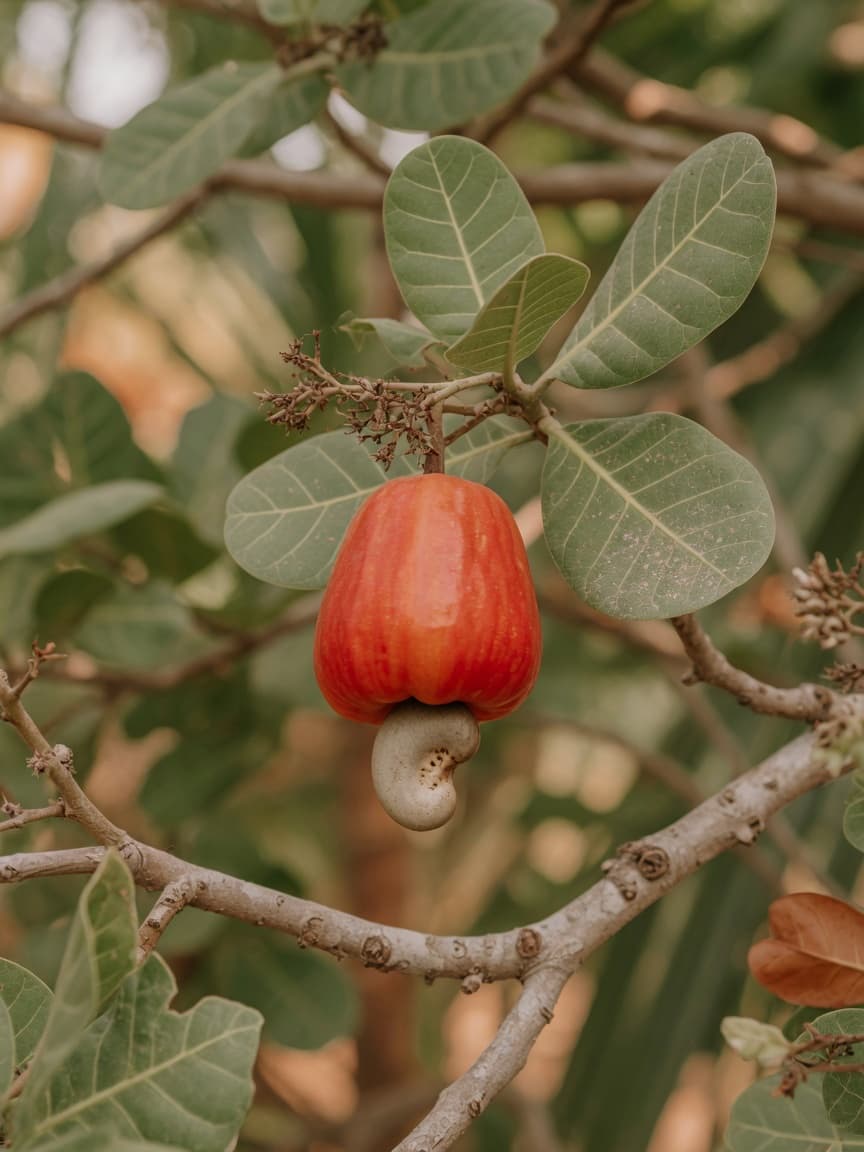
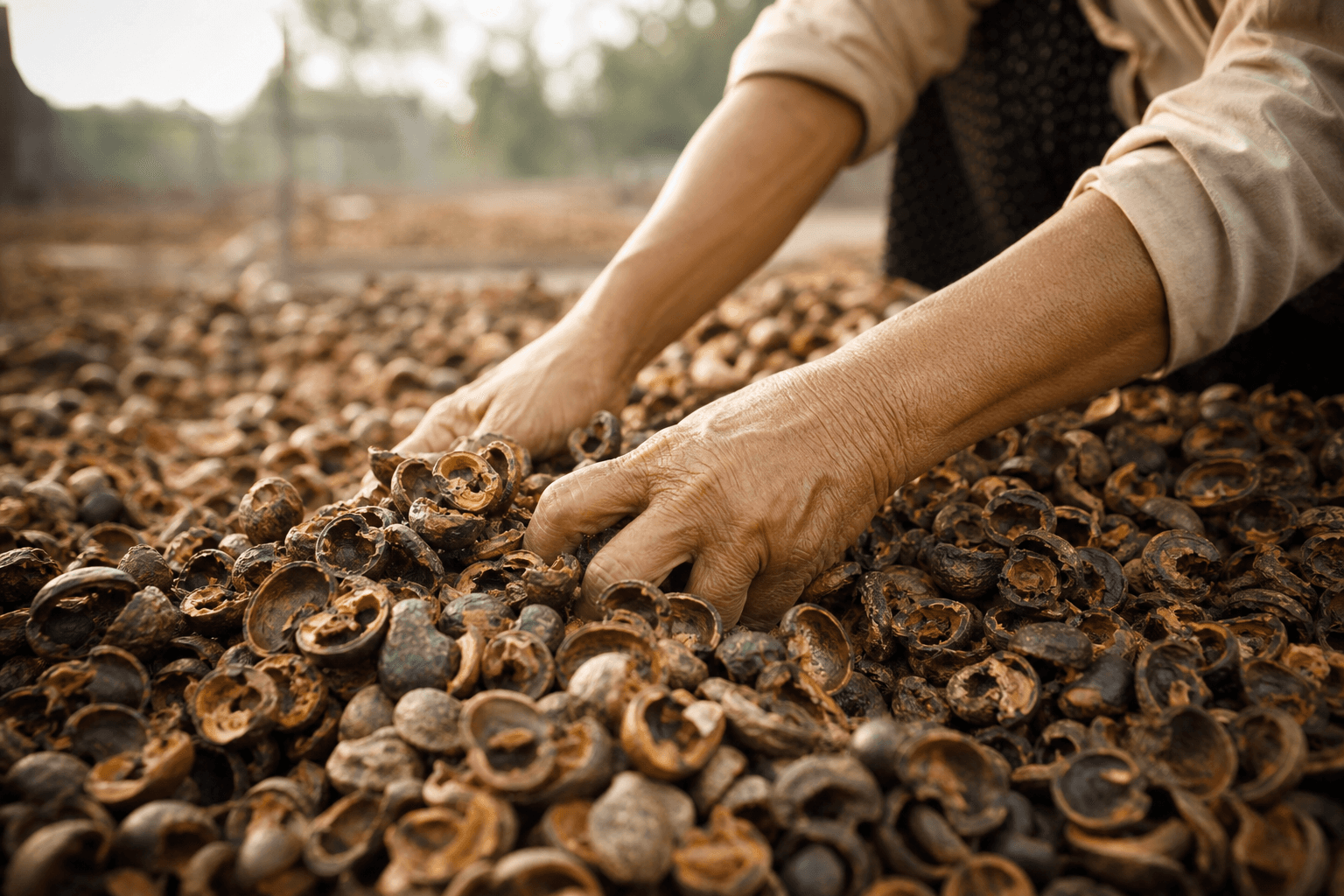
Vietnam is one of the world's largest cashew producers. After shelling and peeling, a thin, reddish-brown layer is left behind: the testa, also known as the cashew skin. It makes up roughly 4–6% of the kernel weight, and in Vietnam it adds up to an estimated 12,000–18,000 tonnes a year.
Despite its high content of valuable natural compounds, most of the testa is still burned in the open or thrown away. Burning it releases harmful compounds, fine particulates and volatile organic pollutants, and it fouls the air and soil across the processing regions.
So there's a double waste. Burning this by-product in the open fouls the local air and soil, and a valuable natural resource goes almost entirely unused by industry.
A German snack company · Intersnack · came to N&E Innovations in Singapore with a specific question: a sizeable share of the cashew harvest is by-product and ends up in landfill. Could something valuable be made from it?
In 2020, N&E Innovations developed a natural plant extract from the cashew testa: Vi-KANG. The underlying process is patent-protected.
Vi-KANG is a unique, sustainably sourced formulation from cashew extract that keeps the natural characteristics of the source material in a reproducible, traceable form.
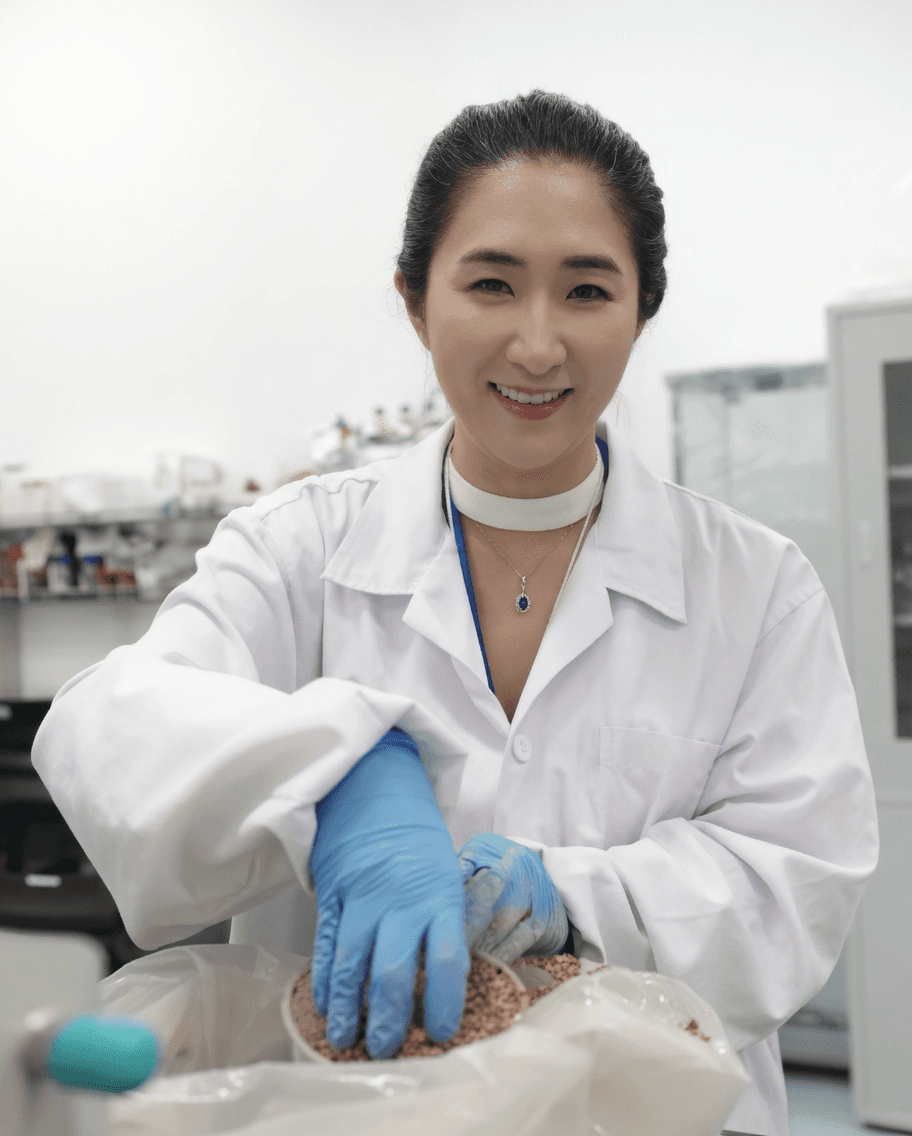



An industry partner brings the problem of unused cashew by-products to N&E Innovations in Singapore.
N&E Innovations develops Vi-KANG · a unique formulation from cashew extract.
The process is patent-protected, covering how Vi-KANG is obtained and applied.
The base of every OKIO product is PBAT · a biodegradable plastic designed for home composting. Vi-KANG is embedded into this material as a plant extract, and it is present in all six OKIO products.
The hard part was getting a circular plant material into a plastic so that it survives in the finished product, without giving up the mechanical and compostable properties of the PBAT. The two come together at the compounding step, before the material becomes film and bags.
OKIO cling film holds OK compost HOME certification from TÜV Austria · verified for breakdown under real home-compost and garden conditions · not only in an industrial plant.
Many products sold as compostable are certified for industrial composting only · typically at 55–60 °C. OK compost HOME requires proof under the cooler, ambient conditions of a home compost heap. Independent testing confirms full biodegradation to mature compost under those conditions · with no adverse effect on soil organisms (earthworm ecotoxicity test). A second independent programme · AS 5810 · supports the same home-compost claim. Beyond cling film, the OKIO range also includes other compostable everyday products · among them trash bags, cosmetic bags, dog-poop bags and gloves.
N&E Innovations grows market by market · from founding in Singapore to entering Europe.
N&E Innovations is founded · the journey begins in Singapore.

The first step beyond home · market entry in Malaysia.

Presence expands across the region · spreading through ASEAN markets.

Australia becomes the first market outside Asia.

The next horizon · N&E Innovations and OKIO launch in Europe.
Won in the food category, with one million US dollars in prize money. The award goes to N&E Innovations, the company behind OKIO. In the film, the founders tell how a question about food waste became a material and a company.
Figures from the N&E Innovations award film.
The orange sequence in the film is a freshness test under home conditions, not a controlled laboratory study. Food stays enjoyable noticeably longer, results may vary.
In 2026, N&E Innovations brought the technology to two markets that take the environment seriously · the EU and Australia. It launched in Australia first, then spun OKIO out as its own brand: biodegradable everyday products with Vi-KANG inside. The name is deliberate · compostable is OK.
You're an investor, partner or journalist and you'd like to know more about the science behind OKIO.